

Dr. Mark A. Bourassa, COAPS/FSU, Tallahassee FL 32306-3041
email: bourassa@coaps.fsu.edu
WWW: http://coaps.fsu.edu/~bourassa
with Dayton G. Vincent1
and W. L. Wood2
1 Department of Earth and Atmospheric Sciences, Purdue University, Indiana 47907, USA.
2 School
of Civil Engineering, Purdue University, Indiana 47907, USA.
A model for significant wave height
is coupled with a surface flux model to remove the (common) assumption
of local equilibrium. The flux model includes the influence of
surface tension (including capillary waves) on wave characteristics
such as the dominant wave period and wave age. The effects of
rising and falling seas are also examined.
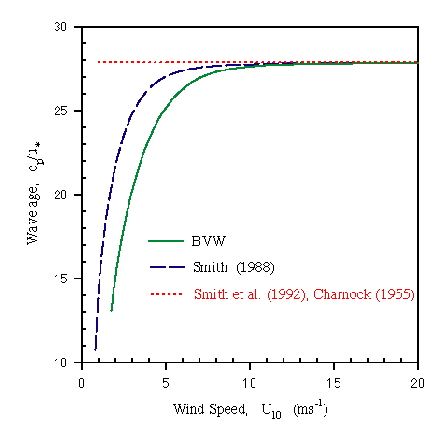
Wave age (cp /
u*)
is a first order estimate of the sea state. Most models assume
that the local-equilibrium value of the wave age is independent
of wind speed. This reasoning is consistent with stress models
(e.g. Charnock, 1955; Smith et al., 1992) that consider
only gravity waves as a source of roughness. Models that also
consider roughness due to other sources will have an equilibrium wave
age that decreases as these source of roughness become more important.
Smith's (1988) model considers roughness due to gravity
waves and molecular viscosity. The BVW model considers stress
due to gravity waves and capillary waves, with molecular viscosity
contributing only when there are no waves present (U10
< ~2 m s-1).
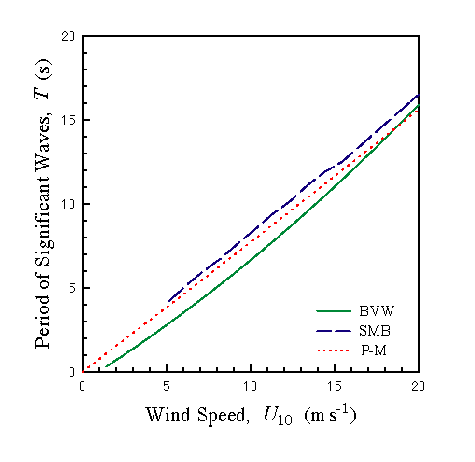
The period of the dominant waves
is often assumed to approach zero as the wind speed approaches
zero (Pierson and Moskowitz, 1964). The BVW sea state
model has a more realistic period: it approaches the 'period
corresponding to the minimum phase speed' as the wind speed approaches
the capillary cutoff. Many models of wave-wave interaction have
terms that are proportional to Pierson and Moskowitz's
period; for low wind speeds, this use of Pierson and Moskowitz's
period could result in large overestimates.

Last Updated in the distant past